Farming at Clermont
Agriculture and Its Context in the Shenandoah Valley
What is now Clermont was first actively “farmed” by Native Americans, who systematically burned the Shenandoah Valley to create an environment in which game could be produced (in hardwood forests) and hunted (in grassland savannahs). Early European settlers commented upon this environment.
The Europeans (German and Scots-Irish from Pennsylvania, English from Tidewater Virginia) who arrived starting in the 1730s in turn farmed based on their experience in the cultures from which they came, in response to the local environmental conditions, labor available, and market demand.
With the migration from Tidewater came enslaved Africans, who by the middle of the 19th century constituted 20% of the population of the Valley, but who were unevenly distributed, with by far the highest number in Clarke County at 50%, because of large early land grants to wealthy Tidewater planters who brought their industrial scale and methods of agriculture with them. At Clermont, the number of enslaved people fluctuated (36 in 1810, 28 in 1860 in three slave houses, but was always in the top one-fifth in the number of slaves held, their labor being essential to the farm's productivity.
With the increasing worldwide demand for wheat from the middle of the 18th century (armies in Europe, food for the Caribbean, where the monocrop was sugar cane), the Shenandoah Valley became the American South’s most substantial producer, shipping flour directly to the international Atlantic market through Alexandria, Baltimore, and Philadelphia. However, even in the Valley, Clarke County was exceptional, producing more than twice the average number of bushels of wheat per capita (42 vs. 20) and outperforming other Valley counties in bushels per improved acre (ranging from 1.46 to 2.99), with its own impressive 5.8 bushels per improved acre.
Clermont and the System of “General Mixed Farming”
Clermont, surveyed by an 18-year old George Washington in 1750, not only participated in that “wheat boom”, but was itself a champion producer within its county (again, top one-fifth in Clarke), using its extensive enslaved labor to produce 2,500 bushels in 1850 (more than twice the average per farm in Clarke) and 4,000 bushels in 1860. Despite the emphasis on wheat as the cash crop, Valley farmers and the owners of Clermont were not monoculturists, but practitioners of what cultural geographers call “general mixed farming”. The diversity of enterprises characterized this system. Every farm raised a wide variety of animals (horses, milk cattle, beef cattle, oxen, sheep, pigs, goats, chickens, turkeys, ducks, guinea fowl, bees) and a variety of crops, often producing at least as much corn as they did wheat, along with other grains (barley, oats, rye), timothy, clover, potatoes, etc.
In the Valley and at Clermont, this practice of general mixed farming continued for almost 200 years, up to the middle of the 20th century, characterized by this diversity of animals and crops, which supported sustainability in two senses:
Economically, if beef prices were down one year, pork prices might be up, evening out the finances
Environmentally, animals and plants are not just products of the farm; they also contribute to the maintenance and productivity of the farm’s basic asset, the land. Animals contribute their manure, pigs help aerate the soil, bees provide pollination, and plants help fix additional nitrogen in the soil, which is crucial to its fertility, as well as holding the soil in place and cleaning groundwater. The more diversity, the more of these actions, and the more environmentally and financially sustainable the farm will be over time.
Changes after World War II included market consolidation, advancements in technology, government agricultural research and support, and a shift in labor availability and cost. By the 1950s, farming in the Valley and elsewhere became more specialized to particular animal or crop operations. These operations were more capital and product-intensive, less labor-intensive, and used more highly developed seed stock, commercial fertilizers, pesticides, herbicides, and feed supplements.
The general mixed farming model declined. At Clermont after 1948, land was used mainly for cattle grazing and hay production; the returns were not significant, investment was limited, and the basic assets (land, herds, buildings, fencing) deteriorated. The rotation of crops and animal use declined, the land became more compacted, and its organic content was lost.
A Renewed Farm, Looking Both to the Past and the Future
In her gifts to the State of the land and to the Foundation of her other assets at her death in 2004, Elizabeth Williams required that active production agriculture continue at Clermont, primarily to maintain what was an historic agricultural landscape as such (based on the knowledge that farms that are not farmed become either forests or houses), but also to support a locally-diminishing agricultural sector and to promote agricultural education. The Foundation, as manager of the 360-acre site, looked for ways to make this condition sustainable in the 21st century.
Research on the history of the farm, talks with farmers and Extension Agents, and analyses performed by students and faculty at Virginia Tech suggested several pathways to re-establish the farm's productivity and usefulness: improvements in the quality and consistency of animal herds, greater diversity of enterprise, marketing related to increasing demand for local production and distribution, etc.
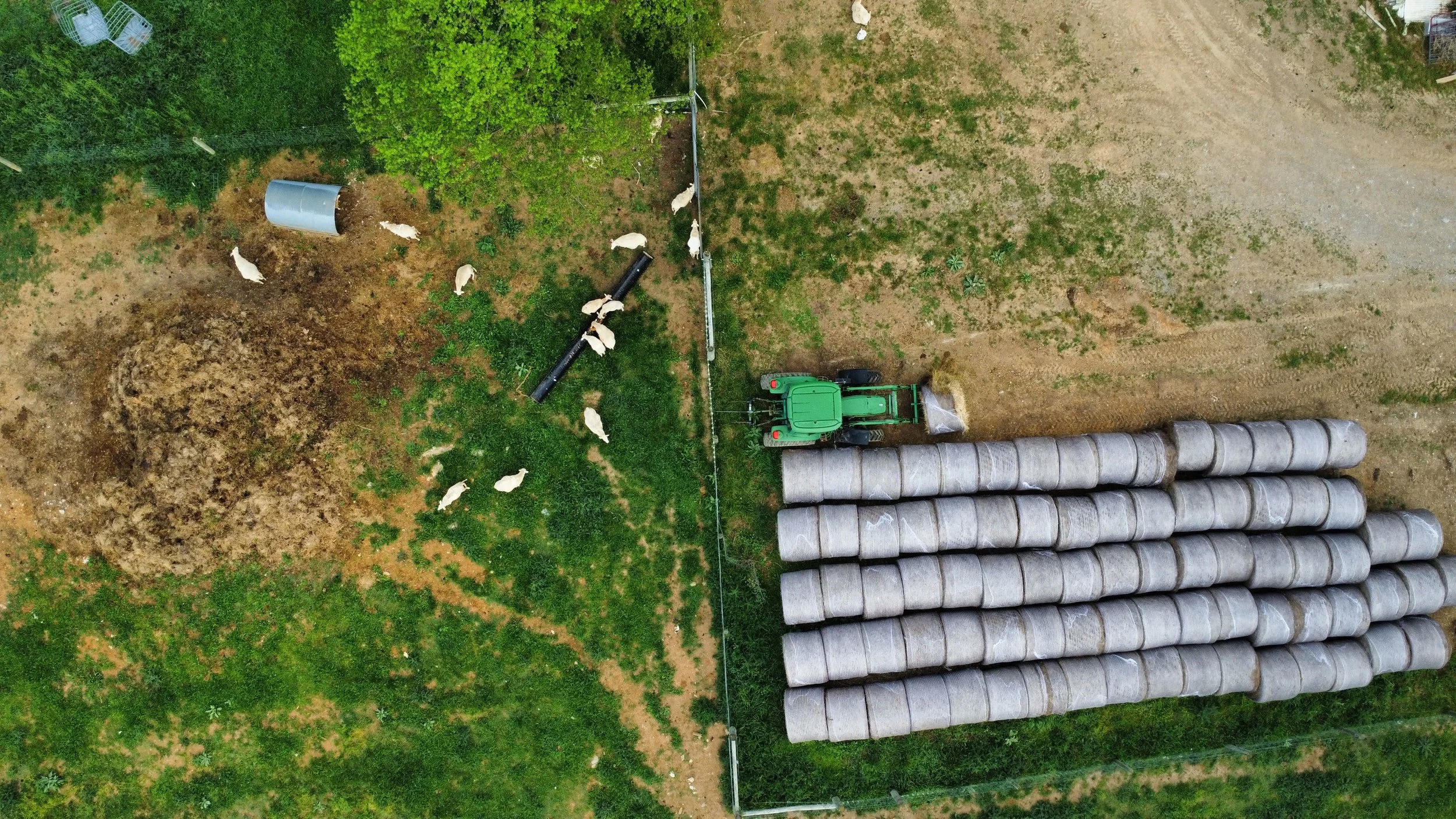
With a renewed commitment to production agriculture, and a new educational mission, the Virginia Department of Historic Resources and the Foundation have worked together to bring back the infrastructure of the farm, to diversify enterprise (sheep were added to the beef cattle, then pigs and bees), to adopt best management practices, consider sustainability throughout, and to develop new partnerships.
These agricultural partnerships include:
Clarke County Public Schools and Farm Bureau, to support agricultural education as their teaching farm
Extension Services, to provide space for classes, field schools, and demo sites for working farmers
USDA’s Farm Services Administration and its Natural Resources Conservation Service for incentivized best management practice contracts from 2007 to 2027.
In 2022 Clermont Farm was given the Clean Water Farm award for the Lord Fairfax Soil and Water Conservation District (Northern Shenandoah Valley) and in 2024 received the Clean Water Farm award for the entire Shenandoah River Basin in western Virginia, presented by the Virginia Dept. of Conservation and Recreation and the Virginia Association of Soil and Water Conservation Districts.
Clermont is a historic place, but its “historic preservation” means it is today a modern working farm informed by historical practice, which also serves the interests of agricultural education and of strengthening the future of agriculture in Clarke County and Virginia.